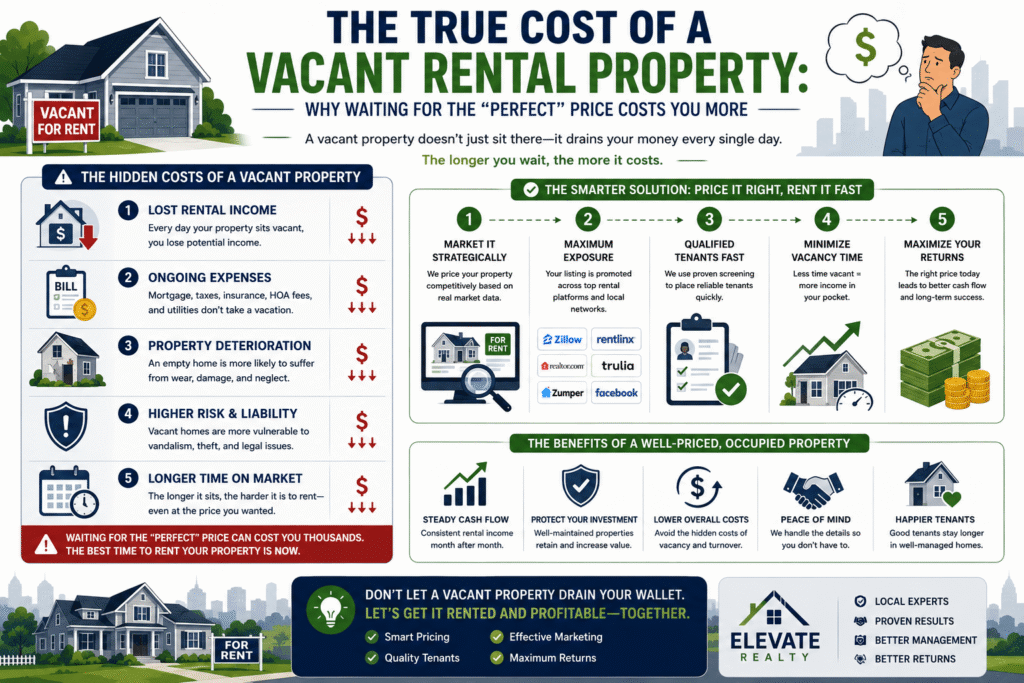
A rental property can look profitable on paper and still lose money quietly.
The mortgage gets paid. Utilities continue. The grass still needs cutting. Insurance does not pause. Meanwhile, the home sits empty because the asking rent is slightly higher than qualified tenants are willing to pay.
Many landlords see reducing the rent as a loss. In reality, holding out for an extra $100 or $200 per month can cost far more than the reduction itself.
Consider a simple example.
A property owner lists a Northern Virginia rental at $2,800 per month. Comparable homes are leasing closer to $2,650. The owner waits 30 days for someone willing to pay the higher amount.
That month of vacancy costs $2,650 in lost market rent.
Even if the owner eventually secures the full $2,800, it would take almost 18 months to recover the money lost during that single vacant month:
$2,650 ÷ $150 = 17.7 months
And that calculation does not include utilities, lawn care, maintenance, advertising, or the possibility of accepting a lower rent later anyway.
The “perfect” price only works when the market agrees with it .
Vacancy Is an Expense, Not Just Missing Income
Owners often think about vacancy as a temporary absence of rent. That is only the most visible part of the cost.
An empty rental continues to generate expenses. Depending on the property, those expenses may include:
- Mortgage payments, taxes, and insurance
- Electricity, water, gas, or internet needed for showings
- Lawn care, pest control, snow removal, or HOA-related upkeep
- Cleaning between tours
- Minor repairs and touch-ups
- Advertising and leasing expenses
- Security checks or extra visits to the property
A vacant home can also require more attention than an occupied one. Someone still needs to confirm that the HVAC is operating, no leak has developed, exterior damage has not occurred, and the property remains presentable.
That means the owner is paying for a property that is producing no income while still demanding oversight.
The Difference Between Asking Rent and Market Rent
An asking price is what the owner hopes to receive. Market rent is what qualified tenants are willing to pay under current conditions.
Those numbers are not always the same.
Online estimates can be useful starting points, but they do not account for every detail that affects leasing. Two homes in the same neighborhood may perform differently because of condition, parking, layout, natural light, appliances, pet restrictions, outdoor space, or proximity to transportation.
Timing matters too. A rental listed on help renting out my house during a slower leasing period may not attract the same demand as it would during peak moving season.
A previous lease is not today’s market
Owners sometimes base a new price on what was last offered on tenant placement services, then add an automatic increase. That approach can work when demand supports it, but past rent does not guarantee present value.
The previous tenant may have signed during a stronger market. Competing rentals may now offer better finishes or incentives. Local inventory may have increased. Tenant budgets may have shifted.
Pricing should be based on what the property is competing against now, not what it earned under different conditions.
The Cost of “Let’s Give It One More Week”
One more week sounds harmless.
But vacancy losses accumulate daily. A property with a market rent of $2,700 loses roughly $90 in rental income every day it remains empty.
Seven additional days represent approximately $630 in lost rent. Two weeks cost about $1,260.
If the owner is holding out for an additional $100 per month, that extra two-week wait would take more than a year to recover.
This is where emotion can interfere with the decision. Lowering the price may feel like giving something away, while leaving the property vacant feels temporary. Financially, however, the vacancy is often the larger concession.
A modest adjustment made early can protect annual income better than a higher monthly rate secured too late.
Your Listing Activity Is Giving You Information
The market rarely sends a formal message saying the rent is too high. It communicates through tenant behavior.
Few inquiries
If the listing receives very little attention, the price may be outside the range renters are using in their searches. Presentation can also be responsible, especially when photographs are poor or the description leaves out important features.
Still, when similar properties are generating interest and yours is not, price deserves a serious review.
Showings but no applications
This usually means the listing attracted attention, but the property did not deliver enough value in person.
The issue could be rent, condition, cleanliness, layout, or something tenants only notice during the tour. Repeatedly hearing “We are still looking” is not neutral feedback. It is a pattern.
Applications from poorly qualified prospects
A property can attract inquiries while still being positioned incorrectly. If stronger applicants consistently choose competing homes, the remaining applicant pool may not meet the owner’s screening standards.
The solution is not to weaken screening. It is to improve the property’s value proposition through better pricing, presentation, or both.
The Best Price Is Not Always the Highest Price
A successful rental price does several jobs at once.
It attracts attention from qualified tenants, supports the property’s income goals, reflects the home’s condition, and reduces unnecessary vacancy.
The highest possible monthly rent does not automatically produce the strongest annual return.
Imagine two outcomes:
Option A: The property rents for $2,800 after sitting vacant for six weeks.
Option B: The property rents for $2,675 after ten days.
Option A sounds better because the monthly payment is higher. But once the extra vacancy is considered, Option B may generate more income over the first year.
It may also reduce other risks. A properly priced home often receives more qualified interest, gives the owner better applicant choices, and prevents the listing from becoming stale.
Stale Listings Create Their Own Problems
Tenants pay attention to how long a property has been available.
When a listing remains active for several weeks, renters may begin to wonder whether something is wrong with the home. Some assume the landlord is difficult. Others expect there is room to negotiate because the property has not moved.
Repeated price reductions can reinforce that impression.
This does not mean owners should panic after a few quiet days. Lease management services should be reviewed in context. But waiting too long to respond can weaken the listing’s position.
An early, evidence-based adjustment usually looks more intentional than several small reductions made after the property has already lost momentum.
Before Lowering the Rent, Check the Rest of the Offer
Price is important, but it is not the only reason a rental sits vacant.
Before making a change, look at the complete leasing experience:
- Are the photographs bright, current, and accurate?
- Is the description useful, or does it rely on vague language?
- Is the property easy to show?
- Is it clean and ready for move-in?
- Are pet rules or income requirements unnecessarily restrictive?
- Is the security deposit creating an avoidable barrier?
- Does the listing clearly explain parking, utilities, amenities, and location?
A property priced correctly can still struggle if the marketing is weak or access is difficult.
On the other hand, better photographs cannot permanently compensate for an unrealistic rent.
Price for the Year, Not for the Month
The better question is not, “What is the most I can charge?”
It is, “What price gives this property the strongest realistic annual performance?”
That requires looking beyond the monthly figure. Vacancy, turnover, leasing expenses, tenant quality, and retention all affect the result.
A well-qualified tenant who moves in sooner and stays longer may be worth significantly more than a slightly higher rent paired with extended vacancy or frequent turnover.
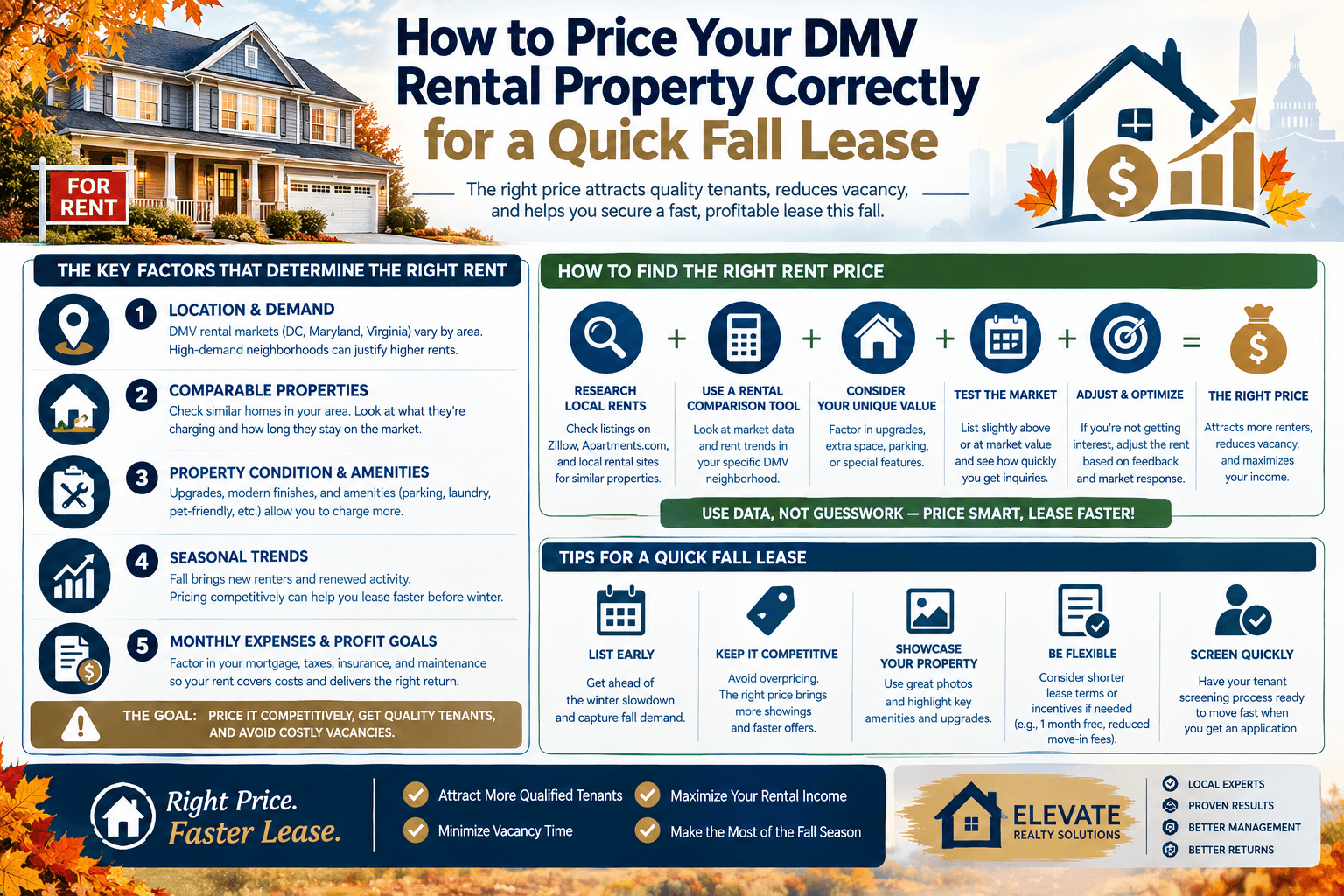
For property owners in Washington, D.C., Maryland, and Northern Virginia, local demand can vary by neighborhood, property type, season, and even commute patterns. Pricing decisions should be based on current comparable rentals and actual tenant response—not wishful numbers or automated estimates alone.
At Elevate Realty Solutions, we help owners evaluate the complete picture: competing listings, property condition, leasing activity, and the cost of waiting.
There is nothing wrong with wanting the best possible rent. The mistake is treating the highest asking price as the only measure of success.
A rental property earns money when a qualified tenant is living in it—not when the listing displays the number the owner hoped to receive.