Firing a property management company is rarely an easy decision.
The manager may have been with you for years. They may know the tenant, hold the security deposit records, coordinate ongoing repairs, and control access to important documents. Even when the service has deteriorated, changing companies can feel like inviting more disruption.
That hesitation is understandable. No management company operates perfectly every day. A delayed response, an accounting correction, or a vendor who misses an appointment does not automatically justify ending the relationship.
The real concern is repetition.
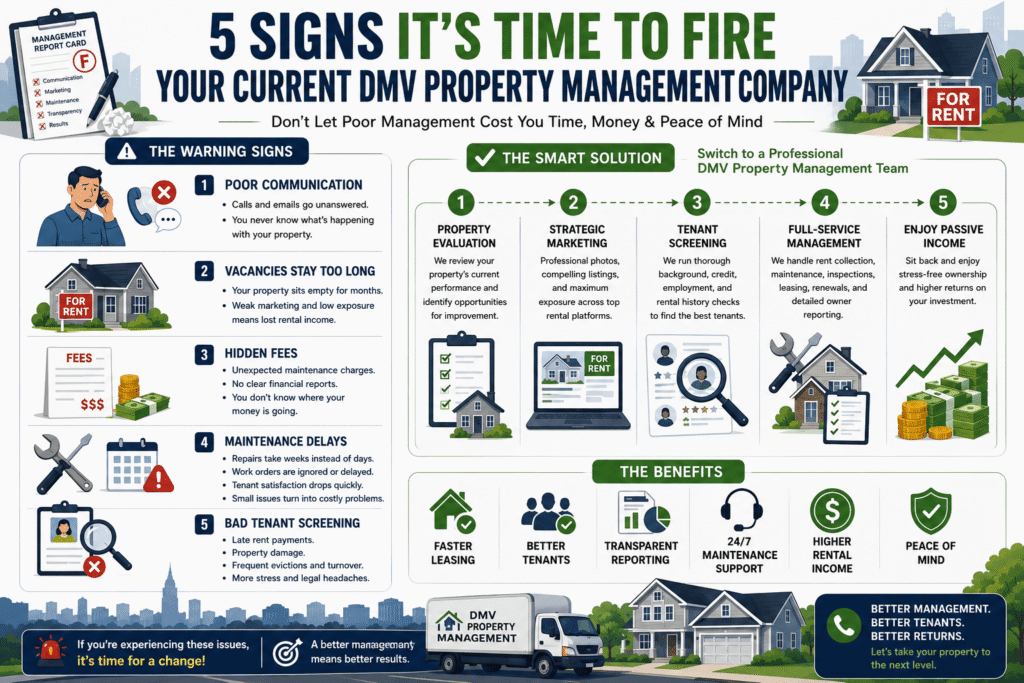
When the same problems keep returning and the owner has to step in repeatedly, the management arrangement may no longer be protecting the property. Here are five signs that DMV rental owners should take seriously.
1. You Have Started Managing the Property Manager
The clearest warning sign is often not one dramatic failure. It is the amount of time the owner spends checking whether routine work has been completed.
You send a message asking about a repair. Two days later, you follow up. Then you contact the tenant to confirm whether anyone visited. At the end of the month, you review the statement and discover that the invoice still lacks an explanation.
Technically, the property manager may be doing some of the work. But you are directing, reminding, verifying, and closing the loop.
That is management.
A property owner should remain informed and involved in major decisions. However, there is a meaningful difference between oversight and supervision. Oversight means reviewing performance and approving important expenses. Supervision means chasing updates, reconstructing conversations, and reminding professionals to handle responsibilities they already accepted.
Look at your last 60 days
Ask yourself how often you had to:
- Request the same information more than once
- Contact the tenant because the manager did not respond
- Remind the company about a lease deadline
- Ask whether rent had been received
- Follow up on an unresolved work order
- Correct basic property or tenant information
One isolated incident may be fixable. A recurring pattern means the company’s systems or its level of attention are not strong enough for your property.
2. The Financial Statements Create More Questions Than Answers
A monthly owner statement should help you understand what happened financially. It should not force you to become a forensic accountant.
You should be able to identify the rent collected, management fees charged, maintenance expenses paid, outstanding balances, and the amount distributed to you. Supporting invoices should match the expenses shown.
Problems begin when charges appear without context, descriptions are vague, or the numbers change after you ask about them.
A $275 maintenance charge labeled only as “repair” is not useful. Neither is an owner statement that shows a tenant balance without explaining whether the amount is late rent, a fee, a credit, or an accounting adjustment.
Occasional errors can happen. What matters is how the company responds. A capable manager should investigate quickly, explain the issue in plain language, and correct the record when necessary.
Repeated discrepancies are different. They weaken the owner’s ability to evaluate the property and may create larger problems at tax time, during a sale, or when records must be transferred.
Financial transparency is not an extra feature. It is part of the basic service.
3. Maintenance Is Either Neglected or Approved Too Casually
Maintenance failures usually appear in one of two forms.
In the first, the manager moves too slowly. Tenant requests remain open, vendors are not scheduled, and small problems become expensive ones. A slow response to a minor leak, HVAC concern, or exterior issue can damage the property and the tenant relationship at the same time.
In the second, the manager spends too freely. Work is approved without a clear diagnosis, invoices lack detail, or the same vendor is used repeatedly without reasonable cost control.
Neither extreme serves the owner.
Cheap management can become expensive ownership
A low management fee means very little if the company fails to protect the property.
Deferred repairs may lead to larger replacement costs. Poor communication can frustrate a reliable tenant. Weak vendor oversight can result in repeat visits for the same problem. An owner may also pay for work that could have been avoided with better troubleshooting.
Strong maintenance management does not mean selecting the cheapest option every time. It means understanding the issue, responding at the appropriate speed, using dependable vendors, documenting the work, and keeping the owner informed when approval is needed.
Owners should also be cautious when every repair is described as an emergency. True emergencies require immediate action. Routine work should not continually bypass normal approval and cost-review procedures.
4. Good Tenants Are Becoming Frustrated
Some landlords first discover management problems when the tenant contacts them directly.
The tenant may say that no one returned a message, a repair has been open for weeks, or they received conflicting instructions from different people. In other cases, the owner only learns about the frustration when a reliable tenant decides not to renew.
Tenant complaints should be evaluated fairly. Not every demand is reasonable, and a property manager sometimes has to enforce lease terms that a tenant dislikes.
Still, recurring complaints about communication, maintenance, payment records, or basic professionalism should not be dismissed.
A good tenant is part of the financial health of a rental property. When that tenant leaves, the owner may face vacancy, cleaning, repairs, marketing costs, and the uncertainty of a new tenancy.
The question is not whether the manager always keeps the tenant happy. The question is whether the manager communicates clearly, documents issues properly, applies the lease consistently, and handles people with professionalism.
When strong tenants repeatedly feel ignored, the owner eventually pays for it.
5. The Company Becomes Defensive Whenever You Ask Reasonable Questions
A healthy management relationship can withstand scrutiny.
Owners should be able to ask why a repair cost increased, whether the rent remains competitive, how a tenant issue is being handled, or what happened to a missing document. Those are not attacks. They are reasonable questions about a valuable asset.
A weak manager may avoid specifics, blame the tenant, blame the vendor, or respond as though the owner is being difficult simply for requesting clarity.
Watch for answers such as:
- “We’re handling it.”
- “That is just how these situations work.”
- “We already sent you everything.”
- “You’ll need to speak to someone else.”
None of these statements necessarily proves poor management on its own. The problem is when vague responses replace evidence, timelines, or accountability.
Professional managers do not need to have every answer immediately. They do need to acknowledge the question, investigate it, and provide a useful response.
When communication becomes defensive, the relationship often stops improving. The manager focuses on protecting the company instead of solving the owner’s problem.
Before You End the Agreement, Check the Contract
Recognizing poor service is only the first step. The transition must still be handled carefully.
Review the management agreement for its termination clause, notice period, cancellation fee, and any obligations involving active leases or pending tenant placement. Identify who currently holds the security deposit and how records, keys, tenant funds, and owner reserves will be transferred.
You should also request copies of essential documents, including:
- The current lease and all addenda
- Tenant ledgers and payment records
- Inspection reports and property photographs
- Open maintenance requests
- Vendor invoices and warranties
- Security deposit records
- Notices sent to or received from the tenant
- Keys, remotes, codes, and access information
Do not wait until the final day to begin gathering these materials.
Where legal obligations or disputed funds are involved, consider obtaining advice from a qualified local professional property management services. Requirements can differ across Washington, D.C., Maryland, and Virginia, and a poorly managed termination can create problems even when the decision to change companies is justified.
The Standard Is Not Perfection. It Is Reliability.
Every property management company will encounter difficult tenants, delayed vendors, unexpected repairs, and occasional mistakes. Those situations are part of managing rental property.
The test is whether the company responds with ownership, clarity, and follow-through.
A capable manager makes a mistake, explains it, corrects it, and improves the process. A failing manager repeats the same mistake and leaves the owner to absorb the consequences.
If you are constantly managing the manager, questioning the financial records, worrying about neglected repairs, hearing avoidable tenant complaints, or fighting for straightforward answers, the problem may be larger than one disappointing month.
Changing property management companies involves work. Remaining with the wrong one can cost considerably more.
At Elevate Realty Solutions, we help DMV property owners review their current situation, understand what a management transfer requires, and move forward without allowing rent collection, maintenance, or tenant communication to fall through the cracks.