A rental can sit vacant for a surprisingly simple reason: the asking rent is wrong.
Not wildly wrong. Sometimes it is just $100 or $150 above where today’s renters see value.
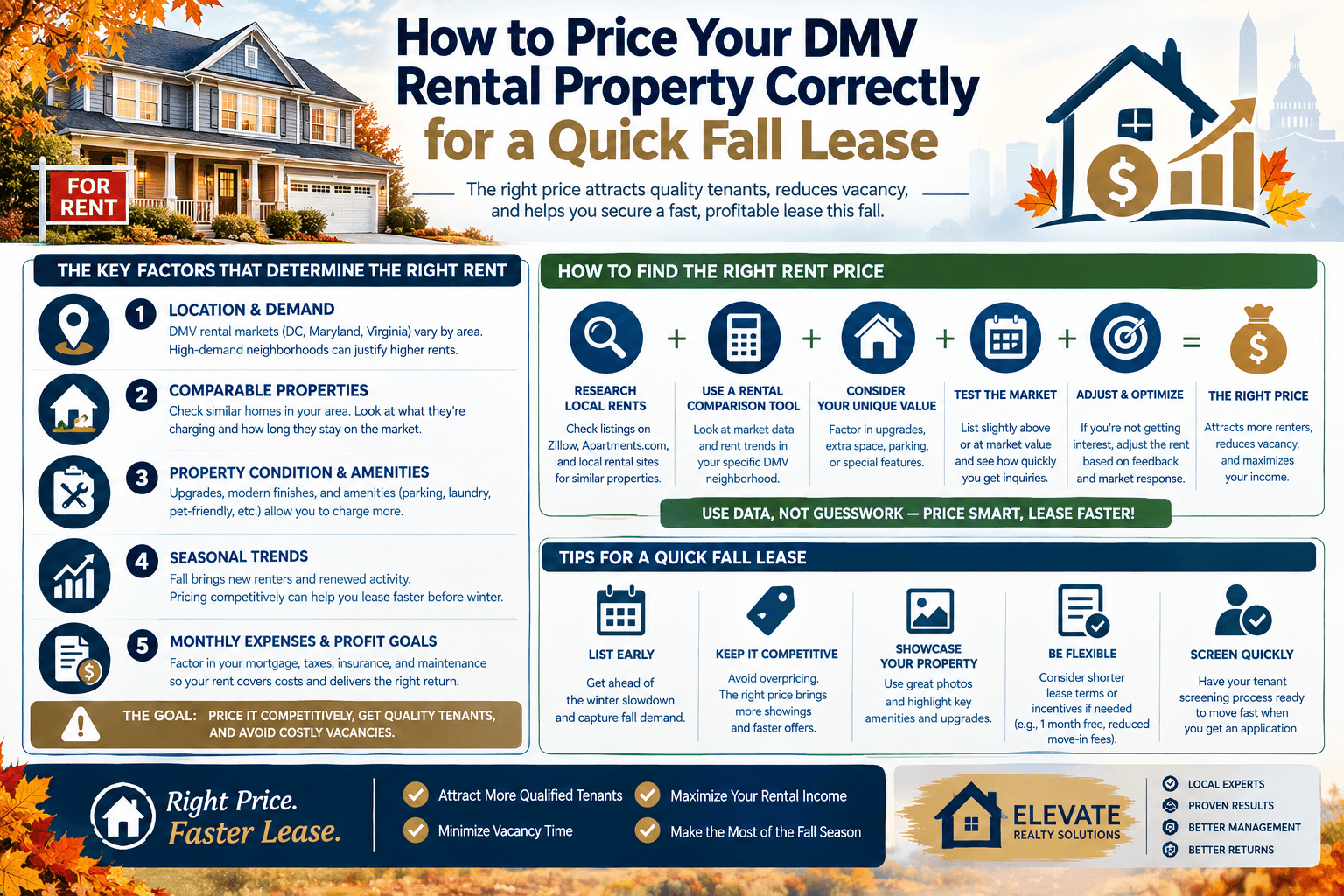
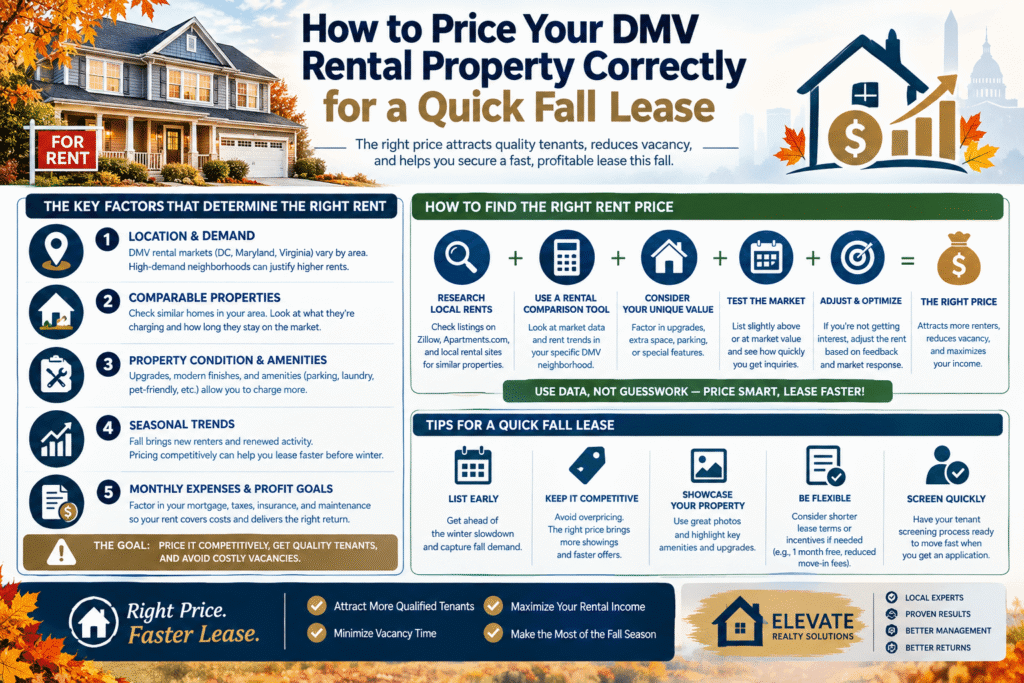
That gap can be expensive in the DMV, where a property competes on location, condition, parking, commute, updates, amenities, and how quickly a renter can picture living there.
If your goal is a quick fall lease, the answer is not “charge as much as possible.” It is to find the price that makes sense for the property and today’s renters.
Start With The Property, Not Your Mortgage
Your mortgage, taxes, insurance, and desired profit matter to your investment strategy. They do not determine what a renter will pay.
A tenant is comparing your home with other homes available today.
So pricing should begin with the market, then work backward into your investment numbers.
| Compare | What to look for |
|---|---|
| Location | Similar neighborhood and commute |
| Size | Comparable bedrooms and bathrooms |
| Condition | Updated, average, or dated |
| Amenities | Parking, yard, basement, laundry |
| Availability | Current and recently leased homes |
| Price | Asking rent and market response |
Your Three Best Pricing Clues
What is available now?
Active listings show your immediate competition. Search for homes a renter could realistically choose instead of yours.
Compare condition, photos, included utilities, parking, pet policies, and move-in dates. A home advertised at $2,700 may be weaker competition than one at $2,800 if the second is renovated and offers features renters value.
What leased recently?
Recently rented properties can tell you more than a long list of stale listings.
If similar homes are repeatedly leasing around a certain range, that is useful evidence.
How are competing listings performing?
If comparable properties have been sitting for weeks, repeatedly reducing prices, or remaining available after their advertised move-in dates, that tells you something.
The asking price is not the market. Renter behavior is.
The “Perfect” Rent Can Cost You Money
Imagine your home could reasonably lease for $2,800, but you list at $3,000 to test the market.
You receive inquiries, but nobody applies.
After two weeks, you reduce it to $2,900. Another week passes. You finally reach $2,800.
On paper, you only gave up $200 per month.
But if the higher price created three weeks of vacancy, the calculation looks very different. At $2,800 per month, three weeks of lost rent is roughly $1,937.
That is why pricing a rental is not simply about maximizing monthly rent. It is a vacancy decision too.
Watch The First 7–10 Days
The first stretch after a listing goes live gives you useful information.
Pay attention to inquiries, showing requests, feedback, and applications.
Strong attention but no applications can mean several things. Maybe the price is slightly high. Maybe the photos create expectations the property does not meet. Maybe renters are choosing a better-maintained home at a similar price.
Very little interest is different. If a property receives almost no serious inquiries, price should be one of the first things you question.
Do Not Change The Rent Every Time Someone Complains
Not every renter who says “too expensive” is giving you reliable market feedback.
People negotiate. Some will always want a lower price.
Look for patterns instead.
If multiple prospects independently react to the price, comparable listings are sitting at lower numbers, and your property is receiving attention without applications, you have stronger evidence that the pricing strategy needs another look.
Price And Presentation Have To Agree
A well-priced property can still struggle if the listing makes it look ordinary.
Good photos matter. So does accurate copy.
If the home has a renovated kitchen, fenced yard, garage, finished basement, or convenient transit access, make those facts easy to understand.
Pricing should reflect the property renters actually see, not the version you remember after the last renovation.
Keep The Pricing Process Fair
Pricing and marketing also need to be handled consistently and lawfully.
The federal Fair Housing Act prohibits discrimination in housing based on race, color, national origin, religion, sex, familial status, and disability. HUD also makes clear that housing advertising cannot express discriminatory preferences or limitations.
Keep your rental criteria, advertised terms, and pricing practices consistent.
A Simple Fall Pricing Test
Before putting your property on the market, ask:
- Is my rent supported by genuinely comparable homes?
- Am I comparing current competition, not just old listings?
- Does the property’s condition justify the price?
- What will I do if serious interest is weak after the first week?
- How much would another week of vacancy cost me?
Those answers are more useful than picking a number because a neighbor listed at it.
When A Local Rental Analysis Is Worth It
You can research comparable rentals yourself. But the DMV is not one uniform rental market.
A property in one neighborhood can behave differently from a similar property several miles away. Even nearby homes can differ because of street, transportation, condition, and features.
That is where a local rental analysis can help. Instead of relying on a few search results and a guess, you can look at the property in the context of its actual competition.
Elevate Realty provides rental price analysis as part of its property management and leasing services, helping owners evaluate their property against the local market before setting an asking rent.
The goal is not to find the highest number you can put in an advertisement.
It is to find a number that attracts the right attention, reflects the property’s real value, and gives you a realistic chance of getting the lease signed without paying for unnecessary vacancy.
For a fall rental, that balance matters.
The best price is not the one that looks best on paper.
It is the one the market is willing to pay, before you list it.