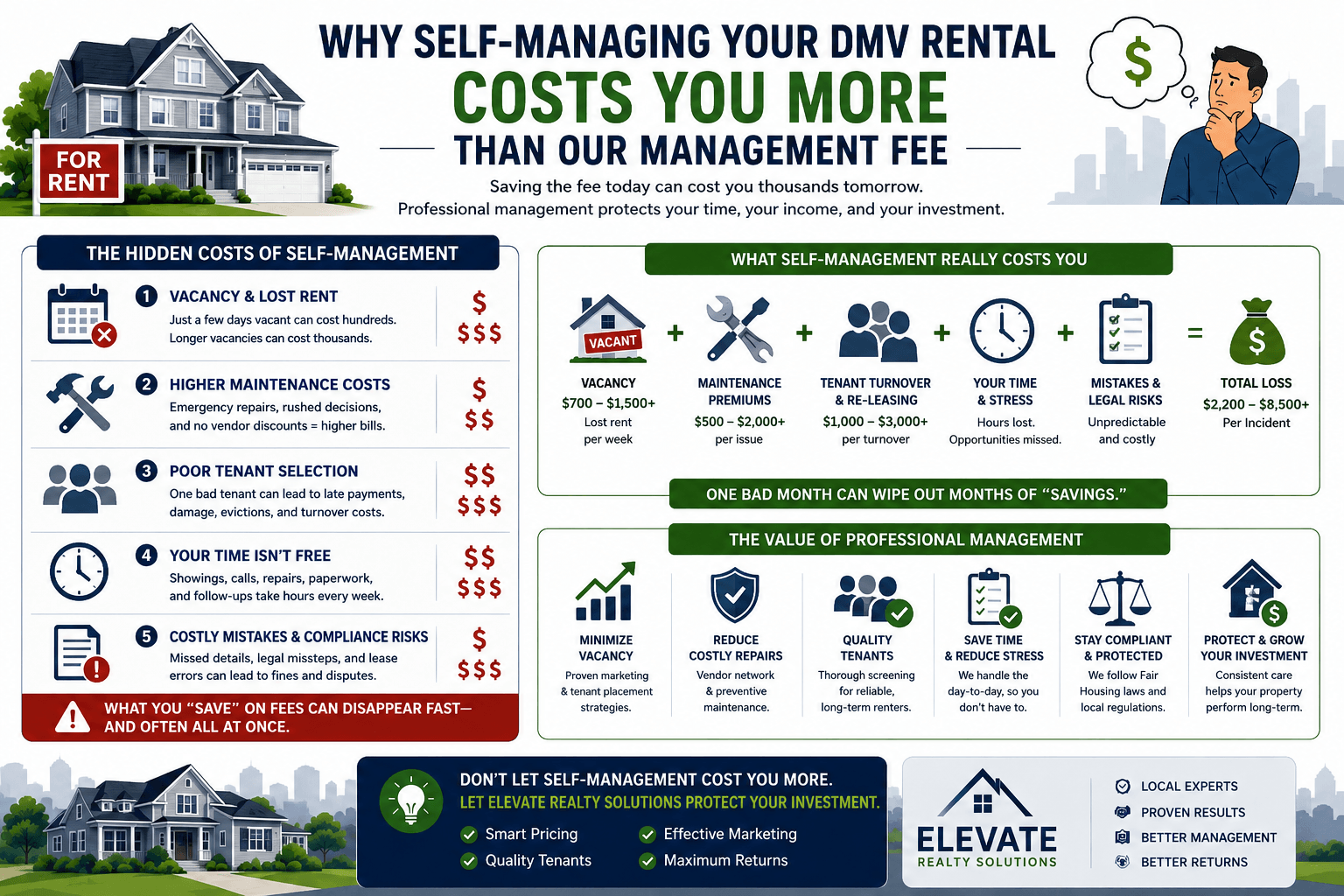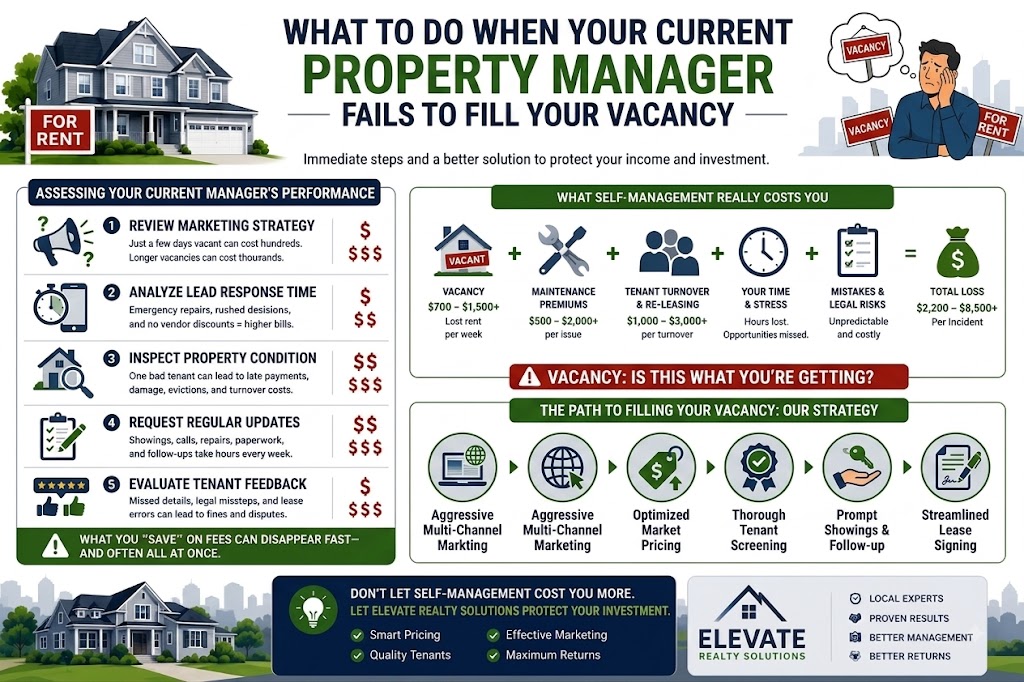

Managing your own rental property can look like the obvious way to save money.
Why pay someone else to collect rent, answer tenant questions, coordinate repairs, or arrange showings when you can do those things yourself?
For some landlords, self-management makes perfect sense. If you have one property, live nearby, have a flexible schedule, and genuinely enjoy handling the details, doing it yourself may work well.
But there is one cost that often gets left out of the comparison:
Your time.
A property management fee is easy to see on a statement. The hours you spend dealing with your rental are not.
That makes the real question less about whether you can manage the property yourself and more about whether doing so is the best use of your time.
Start With What Your Time Is Actually Worth
Suppose you value your professional time at $50 an hour.
Now imagine your rental takes four hours of your time in an average month between tenant communication, maintenance coordination, bookkeeping, inspections, paperwork, and following up on small issues.
That’s $200 worth of your time.
Over a year, you’re looking at roughly $2,400.
And that’s before a tenant moves out, a major appliance breaks, or a vacancy requires several weeks of extra work.
You do not necessarily need to use your salary as the hourly figure. Think about what an hour of your time is worth to you personally.
Could you use that hour to work, grow your business, spend time with family, manage other investments, or simply have it back?
Once you put a number on your time, self-management starts looking different.
The Quiet Hours Are Not the Problem
Routine rental management is rarely difficult.
That’s precisely why many owners decide to handle it themselves.
Rent arrives. The tenant is happy. Nothing breaks. There are no vacancies. You check the account and move on with your day.
The problem is that rental ownership is not defined by its quiet months.
It is defined by what happens when something changes.
A tenant gives notice.
A prospective renter wants to see the property tomorrow.
The furnace stops working.
Rent is late.
A contractor needs access.
A lease is approaching expiration.
A tenant reports water under the kitchen sink.
None of these situations is necessarily a crisis. But each one requires someone to take responsibility for it.
And responsibility takes time.
Count the Work You Don’t Put on Your Calendar
Most owners remember the obvious tasks.
They forget the small ones.
A text from a tenant takes five minutes. A call to a contractor takes ten. Checking whether the contractor showed up takes another five. Responding to an applicant takes another ten.
Individually, those tasks feel insignificant.
Multiply them across twelve months and they become a recurring commitment.
Try tracking every rental-related task for 30 days.
Include:
- Tenant calls and messages
- Showing coordination
- Application follow-up
- Maintenance calls
- Contractor scheduling
- Rent-related communication
- Lease paperwork
- Inspection time
- Bookkeeping and documentation
- Renewal conversations
- Time spent researching answers to problems
Then add the hours together.
The result may surprise you.
More importantly, it gives you a number you can actually compare with professional management.
Then Come the “One-Off” Problems
The monthly workload is only half the calculation.
Turnover can completely change it.
When a tenant moves out, the owner may suddenly need to coordinate an inspection, assess repairs, prepare the property, market the rental, respond to inquiries, schedule showings, review applications, select a tenant, prepare the lease, and coordinate the move-in.
A month that normally requires a few hours can suddenly require many more.
The same thing happens with major maintenance.
A broken HVAC system is not simply a repair invoice. Someone has to find the right contractor, explain the problem, schedule the appointment, coordinate access, communicate with the tenant, review the work, and make sure the issue is actually resolved.
The repair may take two hours.
Managing the repair can take considerably longer.
Vacancy Makes Your Time More Expensive
Your time is not the only thing that matters during a vacancy.
There is also the rent you are not collecting.
Consider a rental that should generate $3,000 per month.
That’s approximately $100 in gross rent per day.
If a property sits vacant for 10 extra days because inquiries were answered slowly, showings were difficult to schedule, or pricing was not adjusted when the market gave you new information, the owner has potentially lost around $1,000 in gross rental income.
That does not mean every vacant day is caused by poor management. Markets change, properties need preparation, and good screening takes time.
The point is simpler:
A landlord’s time and a property’s time both have economic value.
Good management has to account for both.
What Are You Really Buying From a Property Manager?
A management company is not valuable simply because it answers emails on your behalf.
The real value should come from taking recurring operational responsibility off the owner’s plate.
That can include leasing, tenant communication, rent collection, maintenance coordination, inspections, renewals, vendor relationships, documentation, and other day-to-day responsibilities.
The exact services and fees vary by company, so landlords should compare them carefully rather than assuming every management agreement provides the same thing.
For Elevate Realty, for example, published management plans include services such as maintenance coordination, portal access, 1099 tax forms, in-lease inspections, lease renewals, and tenant placement, with different pricing depending on the plan.
That distinction matters.
You should not compare a management fee with “doing nothing.”
You should compare it with the actual work you are currently doing yourself.
Build Your Own Comparison Before You Decide
Forget the generic argument that landlords should or shouldn’t manage their own properties.
Run your own numbers.
Start with the annual cost of professional management.
Then calculate how many hours you currently spend managing the property in a typical year. Add extra time for turnover, vacancies, maintenance issues, and other situations that do not happen every month.
Multiply those hours by the value you place on your time.
Then consider the less obvious costs: delayed responses, missed opportunities, stress, interruptions, and the difficulty of dealing with a property when you are unavailable.
Now you have a much more useful comparison.
Not “management fee versus free.”
But:
“What am I paying, and what am I getting back?”
The Best Rental Strategy Is the One That Fits Your Life
There is no prize for being the busiest person in your rental portfolio.
If self-management works, keep doing it.
If it is consuming hours you would rather spend elsewhere, it may be time to reconsider the arrangement.
For DMV landlords, the decision should ultimately come down to more than the percentage charged by a property management company. Look at the workload, the services provided, your property’s needs, your availability, and the value of having someone else responsible for keeping the operation moving.
Your rental property is an investment.
Your time is an investment, too.
Make sure you are treating both accordingly.
If you want to see whether professional management makes financial sense for your specific rental, Elevate Realty can help you compare the workload and management costs based on your property rather than a generic example.